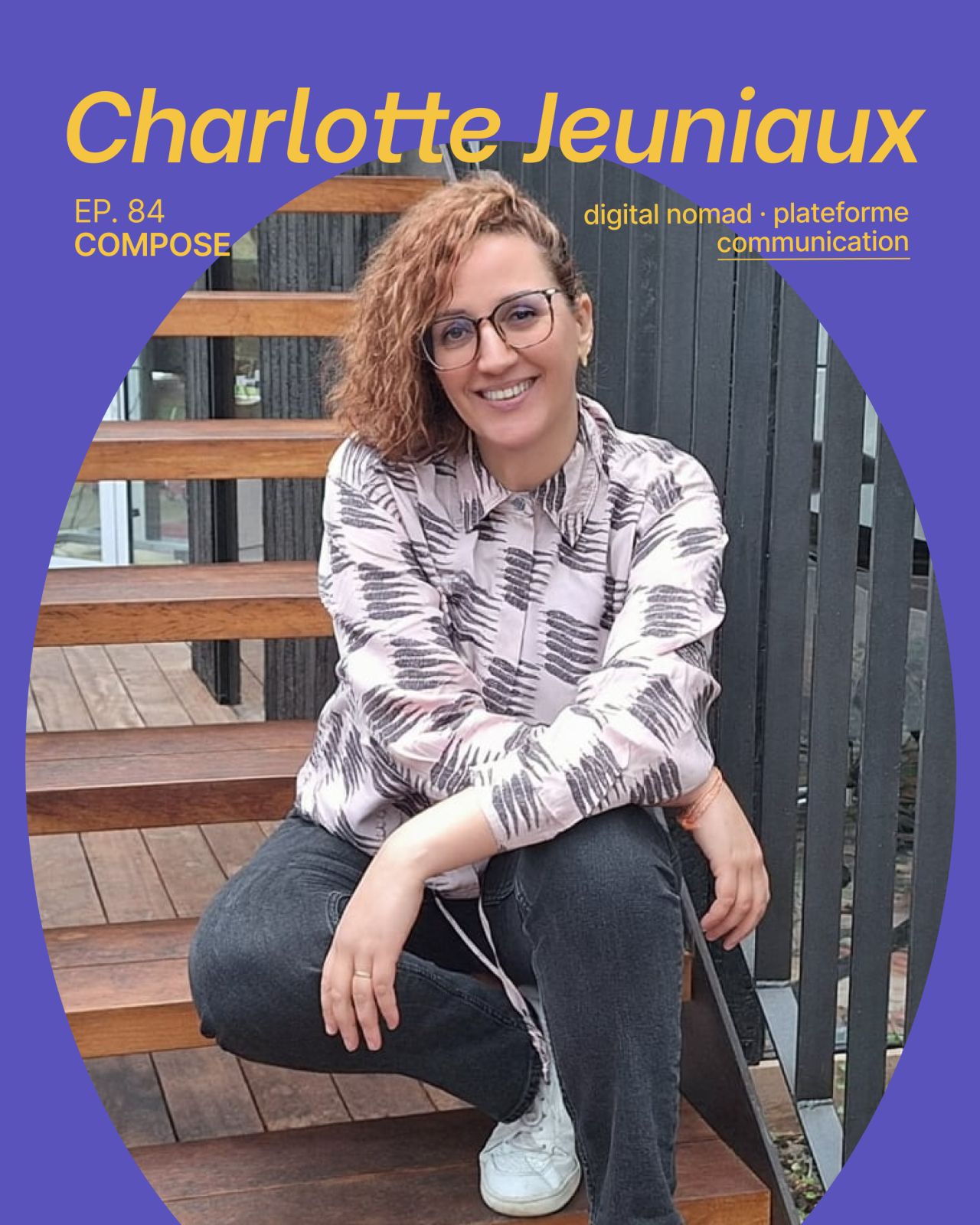
I had the chance to be invited to Compose, the podcast for people who dare to create, to talk about Nomad Impact, my journey, and a question that has been with me for several years: how to use digital skills for truly useful projects? The episode introduces me as a web designer and founder of Nomad Impact, a platform that connects NGOs, non-profits, and communication freelancers, particularly within the framework of the Podcasthon.
This conversation allowed me to put into words what I have been building for a long time, sometimes without formulating it so clearly: Nomad Impact is not just a digital project. It is a way of rethinking the relationship between expertise, grassroots work, and autonomy.
For years, I have supported entrepreneurs, organizations, and projects in their online presence. I have created websites, structured content, clarified offers, and implemented tools. And over time, it became clear: many impact organizations need help, but not necessarily heavy, long, or inaccessible support.
They need competent people, capable of intervening on a specific need, producing something clean, and then transmitting it.
Not just “doing it for them.”
Not just delivering a pretty file.
Not just installing one more tool.
But helping the organization regain control.
The problem is not the lack of tools
We talk a lot about digital transformation. However, in the reality of non-profits and small organizations, the problem is not always the absence of tools. Often, there are even too many.
A website created years ago, but no one really knows how to modify it anymore.
A CRM started with enthusiasm, but now too complex.
A Canva full of visuals, but without a common logic.
Shared files, scattered access, forgotten passwords.
Content produced in a hurry, without a method for evolution.
The real issue, therefore, is not just about digitizing more. It's about making tools understandable, maintainable, and useful.
This is where Nomad Impact finds its place.
Do less, but better
I created Nomad Impact with a deliberately simple ambition: to offer short, framed, expert, and documented missions to help non-profits make concrete progress.
A mission can be small, but valuable: tidying up a website, clarifying a homepage, creating a newsletter template, structuring a mini-CRM, improving SEO, documenting a procedure, or producing reusable communication materials.
What matters is not the size of the mission. It is what it leaves behind.
Does the team understand what was done?
Can they reuse it?
Can they adapt it?
Does the mission reduce dependence or create a new one?
These questions are at the heart of the project.
What nomadism taught me
My journey as a digital nomad has also greatly nourished Nomad Impact. Working remotely, changing contexts, collaborating with different people, learning to document, to transmit, to clarify: all this forced me to develop a form of rigor.
When you can't explain everything orally every time, you have to write.
When you can't be constantly available, you have to make tools readable.
When working with remote teams, you have to simplify processes.
This way of working taught me that a good tool is not just a tool that works. It's a tool that someone else can understand without depending on you.
And that's exactly what I want to bring to impact organizations.
What I hope to change
With Nomad Impact, I would like to help several things evolve.
Firstly, the way we think about digital assistance for non-profits. Too often, it comes in the form of big projects, ambitious redesigns, or oversized technical solutions. However, many organizations primarily need targeted help, at the right moment, with a clear method.
Secondly, the relationship between experts and associations. Freelancers, designers, developers, writers, SEO or CRM specialists can play a valuable role, provided that the missions are well-defined, respectful of everyone's time, and geared towards transmission.
Finally, I would like to evolve our relationship with impact. Impact is not only measured by what we produce, but also by what we enable others to do afterwards.
If a non-profit can update its website by itself, relaunch a campaign, regain access, adapt its materials, understand its CRM, or transmit a tool to a new person on the team, then something has changed.
Perhaps discreetly.
But permanently.
A project in flux
Nomad Impact is not a fixed model. It is a living project, built by moving forward, testing, and listening to the needs on the ground.
This appearance on Compose allowed me to mark a milestone: to tell where the project comes from, why it exists, and what I would like it to make possible.
Ultimately, Nomad Impact stems from a simple conviction: non-profits do not need to be eternally dependent on external providers to manage their digital tools. They need support, yes. Expertise, too. But above all, clear, documented, and reusable tools.
This is what I am trying to build, mission after mission.